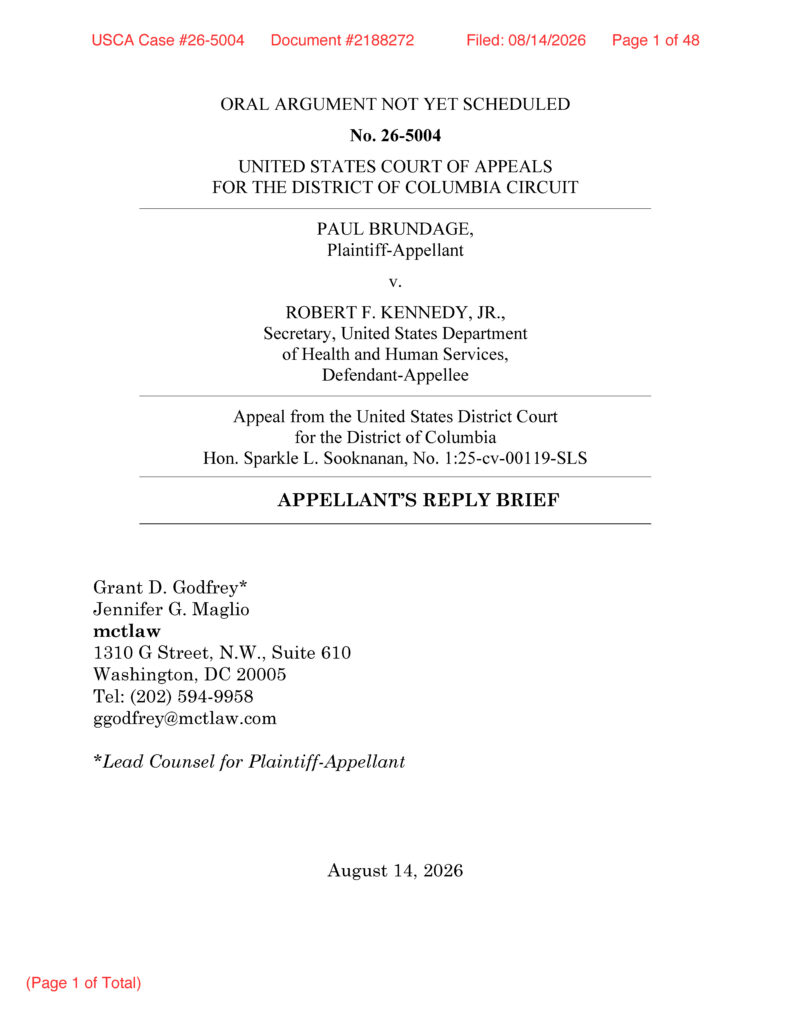

Reply brief says Secretary Kennedy cannot ignore a law and then deny citizens the right to sue to enforce it
Health and Human Services Secretary Robert F. Kennedy Jr. is advancing a legal argument that would make it nearly impossible for citizens to hold federal agencies accountable when they fail to follow the law, according to a reply brief filed by Paul Brundage and his attorneys at mctlaw.
The National Childhood Vaccine Injury Act says the HHS Secretary “shall, within 2 years” add a new vaccine to the Vaccine Injury Compensation Program after the CDC recommends it for routine use in children.
Mr. Brundage alleges that HHS failed to add the COVID vaccine to the Table within that two-year deadline. His lawsuit asks the court to make Secretary Kennedy follow the Vaccine Act, which Congress passed in 1986 and remains federal law today.
The Department of Justice argues on behalf of Secretary Kennedy that Brundage does not have the right to bring a case in court.
Mr. Brundage’s reply explains why he does have legal standing to file a lawsuit and uncovers several major flaws in the Secretary’s position about adding COVID vaccines to the VICP:
- Secretary Kennedy’s delay affects Mr. Brundage personally. Mr. Brundage says he suffered an injury from the COVID vaccine. Adding the vaccine to the Table would move him one step closer to filing a claim for compensation through the VICP.
- The Department of Health and Human Services missed the 2-year deadline, not Congress. Federal law required HHS to add the vaccine to the Table within two years. HHS failed to do this and violated the Vaccine Act.
- The Secretary says Congress must approve a vaccine tax first, but the law does not say that. The Vaccine Act does not require the tax to come before adding the vaccine to the VICP.
- The Secretary’s argument would erase the rights of citizens to sue granted by Congress in the Vaccine Act. Congress gave citizens the right to take legal action when the Secretary fails to perform a required duty. Secretary Kennedy’s arguments would make that protection meaningless.
This case is not asking the court to award Mr. Brundage compensation from the VICP or decide if he’s eligible to file a claim in the VICP. Instead, it asks whether the HHS Secretary must follow a direct command from Congress and whether a citizen affected by HHS’s failure can go to court to hold the Secretary accountable.
“No federal agency or employee is above the law,” says attorney Altom Maglio of mctlaw. “HHS cannot ignore a deadline set by Congress and then argue that no citizen has the right to challenge that failure. If that reasoning is accepted, federal agencies could always avoid accountability by just refusing to do what the law requires.”
A federal district court dismissed the case because it found that Mr. Brundage did not have standing. The court did not decide whether Secretary Kennedy violated the Vaccine Act. Mr. Brundage and his attorneys at mctlaw are asking the U.S. Court of Appeals for the District of Columbia Circuit to reverse that decision and allow the case to move forward.
The case is Paul Brundage v. Robert F. Kennedy, Jr., Secretary of Health and Human Services, Case No. 26-5004.